

When people ask why I didn't choose one of those magnificent five-star hotels in the Val d'Orcia, my answer is simple: there was too much service and too little silence.
For our wine art tour, I wasn't looking for 'accommodation'; I was looking for a state of being. I rejected twenty luxury locations. In one, the sheets were too crisp, too 'sterile' — they killed the spirit of adventure. In another, the staff was too intrusive. In a third, the light hit at an angle that would make our artists squint. To find the place, you have to stop looking at stars on Google Maps and start listening to the earth.
I found this 13th-century abbey by chance, through a tip from an old winemaker. You won't find it on booking sites. It’s a private estate owned by a family of architects who spent ten years meticulously restoring the ruins without turning them into a modern 'renovation.'
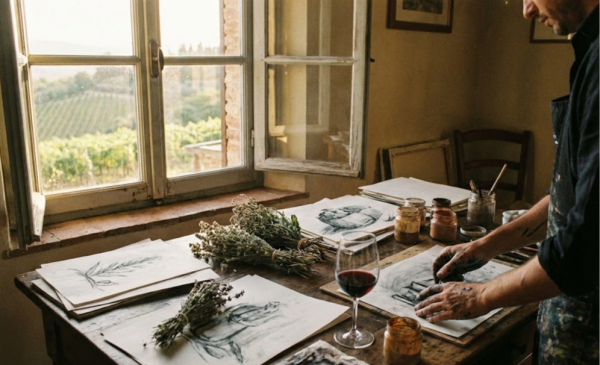
Textures and Light The stone here feels warm and alive under your fingertips. It’s rough, smelling of centuries-old dust and the wild rosemary that grows through the cracks in the garden. In the studio where we paint, the sunrise light isn't just white — it's a milky gold. It settles softly on the easels, and in that moment, time feels suspended. This is the true 'Anatomy of Silence.'
Obsession with Detail My job is the curation of sensations. If we are sketching, we use only handmade vintage paper from a tiny workshop in Fabriano. It has the right weight and tooth; it doesn't tolerate haste. If we drink wine in the evening, it’s not a famous commercial brand, but a bottle from a neighboring farmer whose family has been making Sangiovese for the last three hundred years. That wine tastes of this specific soil, this specific sun.
I believe that a guest's trust is born from my genuine infatuation with the details. When you pick up a piece of charcoal for sketching or raise a glass to your lips, you should feel it: everything here is honest. This isn't a film set. This is a life that we have temporarily made our own.