

Introduction
Recall your last «perfect» vacation. The pristine white sand, the staff anticipating desires before they even formed, the absolute, sterile serenity of a five-star resort. Did you return rested? Or did you return with the same background noise in your head, only now spiced with mild disappointment over money wasted?
If it’s the latter, welcome to the reality of 2026. We have reached the apex of civilizational comfort, only to suddenly discover it is toxic. In a world where any whim is satisfied with a click, and algorithms obligingly feed us content that requires no intellectual effort, we have begun to suffocate.
Today's urban dweller, especially those in top management or the creative class, does not suffer from physical exhaustion. They suffer from an existential void and an overdose of «cheap dopamine.» This is precisely why more and more people are willing to pay serious money not for relaxation, but for tension. Welcome to the era of «Difficult Rest»—the new, true luxury.
The Crisis of Easy Pleasures
Our brain, that ancient survival mechanism, was not designed for the world of 2026. It evolved in conditions of scarcity, where every calorie and every minute of safety was a victory. Today, we live in a world of total surplus. Food, entertainment, social strokes—everything is available instantly and in unlimited quantities.
As a result, our dopamine receptors are «burned out.» We have forgotten how to truly want something because there is no longer a gap between desire and acquisition, no saving friction that gives value to the result.
A traditional beach vacation does not solve the burnout problem because it offers no alternative to habitual neural pathways. Lying on a lounge chair, you continue to scroll through work cases or worry about the future, while your hand habitually reaches for the smartphone. The brain doesn't switch gears; it just changes the location for its anxiety. Comfort doesn't heal the soul; it merely anesthetizes it, requiring ever-larger doses.
Neuroplasticity Through Clay and Rock
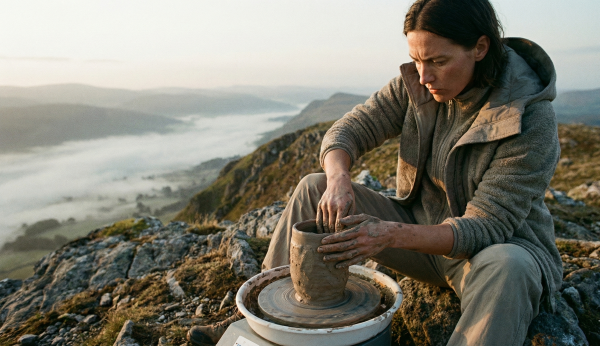
Why are retreats offering asceticism and labor so in demand today? Why does the CFO of a major corporation choose a week of intensive clay work in a remote village over the Maldives, and a famous architect get up at 4 AM to greet the sunrise on a mountain plein air painting expedition with a heavy easel on their back?
The answer lies in the need to reclaim control through physical effort. «Difficult Rest» is an activity requiring total engagement. You cannot think about a quarterly report when your hands are centering a piece of unyielding clay on a potter's wheel. You cannot check email while balancing on a rock climbing route.
Modern research in neuroplasticity confirms what artisans have intuitively felt for centuries: complex manual labor and intense physical concentration are the best therapy for an overloaded neocortex.
When we encounter resistance from material—be it clay, canvas, a mountain path, or our own silence at a Vipassana—we are forced to activate brain zones that sleep during office routine. This is not just a hobby. It is an act of returning to reality. We relearn how to feel weight, texture, muscle fatigue. We ground ourselves. This is a visceral experience that cannot be simulated in virtual reality.
Meaning Over Happiness
At the core of this trend lies a profound philosophical shift. We are gradually moving away from the infantile pursuit of «happiness» (often understood as the absence of discomfort) toward the search for meaning.
A life devoid of challenges becomes unbearably light, and therefore—meaningless. Humans need to feel environmental resistance to sense the boundaries of their own «Self.» By overcoming difficulty—rising before dawn for the perfect shot, wearing fingers raw on guitar strings during an intensive course, enduring a week without a single spoken word—we gain self-respect.
We pay for «Difficult Rest» not because we are masochists. We pay for the opportunity to feel alive again, capable of effort, creating something in the real world. We pay for the silence in which we can finally hear our own inner voice, usually drowned out by digital noise.
Conclusion
The new luxury is not gold faucets or a personal butler. The new luxury is the ability to maintain focus. It is the right to be unavailable to the outside world for the sake of a dialogue with the inner world. It is the opportunity to choose a difficulty you can shoulder and see it through, receiving as a reward not a photo for social media, but a renewed structure of your own personality.
In 2026, real rest is work. But it is work that returns you to yourself.
Find your challenge. Choose your «difficult rest» on FindYourDream.Space.