

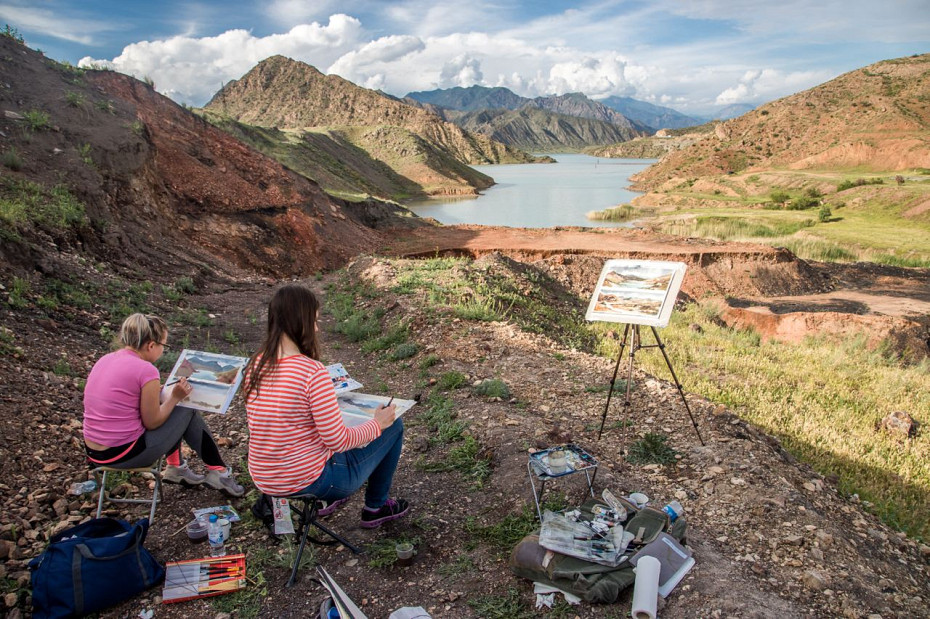
Sooner or later every painter who works indoors hears the call: take the easel outside. The French call it en plein air — “in the open air”. It sounds like the same painting, just with a better view. In practice almost everything changes: how fast you work, what you choose to paint, how you see colour, even why you paint at all.
Here is what really changes when you swap the studio for a hillside, a harbour or a lakeshore, and how to tell which one suits you right now.
What plein air actually means
Plein air painting means painting from life, outdoors, in one sitting or a few short ones — not from a photo and not from memory. The Impressionists made it famous once paint in tubes and the portable easel let them leave the studio. Today it is mostly watercolour, oils, pastel or a simple sketchbook, and the scene in front of you is both the subject and the teacher.
1. The light will not wait
In a studio the light at four o'clock is the same as at ten. Outdoors a shadow crosses a wall within an hour and the colour of the water changes with every cloud. You have roughly one to two hours before the scene you started with is gone.
This is the biggest difference and the best lesson. You learn to decide quickly: where the light falls, where the darkest dark is, what the painting is really about. Many people find their work becomes fresher and more confident precisely because there was no time to overwork it.
2. You have to choose from too much
A still life on a studio table is already composed. Outside you face a whole panorama — boats, hills, rooftops, people walking past. The first skill of plein air is editing: picking one view, leaving out half of what you see and finding a simple shape that holds the picture together. A good tutor spends much of the first day on exactly this — walking with you, framing views and explaining why one spot works better than another.
3. Colour looks different from life
A photo flattens shadows into black and burns out the lights. Your eye sees far more: blue in the shadows, warm reflected light under a roof, the soft edges of distant hills. Painting from life trains your eye in a way photos cannot — and that skill comes back with you into the studio.
4. Weather, wind and onlookers
Plein air is honest about the practical side. Watercolour dries in seconds in the sun and refuses to dry in damp air. The wind lifts the paper, the light glares off a white sheet, and passers-by stop to look over your shoulder. None of it is a disaster — a hat, a couple of clips, a small stool and a limited palette solve most of it — but it is a different kind of concentration from a quiet studio.
5. The place becomes part of the painting
In a studio you paint a subject. Outdoors you remember a place: the sound of the market, the smell of the lake, the person who brought you coffee. A plein air sketchbook slowly turns into a travel diary. That is why so many painting holidays are built around plein air — the journey and the painting become one experience.
What the studio gives you that the outdoors doesn't
This is not a contest. The studio gives you time, control and calm: you can work on one painting for days, learn technique step by step and correct mistakes without the light running away. For a complete beginner who wants to understand how paint behaves, a few studio classes are a good foundation.
Many artists do both: small, quick studies outside, then larger finished work indoors, using the sketches and the memory of the light. On most painting weeks you will find the same rhythm — painting on location, then a demonstration or a review of the day's work under a roof.
Is plein air right for you?
- Yes, if your painting feels stuck or tight, you want to loosen up, or you would rather remember a place by painting it than by photographing it.
- Yes, even as a beginner, if the group is small and the tutor teaches on location — many painting holidays are open to all levels.
- Start in the studio if you want a calm, step-by-step introduction to materials before you deal with sun and wind.
What to bring on your first plein air week
- A small, light kit: a limited palette of six to eight colours, two or three brushes, a watercolour block or sketchbook.
- A folding stool, a water pot, clips or tape for the wind.
- A hat, sunscreen and layers — mornings by the water can be cool.
- Low expectations for the first day. The first paintings are warm-ups; real progress usually shows by the middle of the week.
Check the event page before you pack: many organisers provide some materials or send their own list.
Where to try plein air
A painting holiday is the easiest way in: the tutor chooses the spots, plans the day around the light and takes care of the logistics, so all you have to do is paint. For example:
- Watercolour Painting Holiday at Lake Skadar, Montenegro — a week of watercolour with British tutor Karen Pearson, with excursions to paint the lake, the river and old villages.
- Watercolor & Wanderlust: A Destination Art Retreat in La Paz, Mexico — six days of painting with artist Kristina Eisenhower, open to all levels, from your very first paint set to years at the easel.
- Michael Solovyov: Art Tour to Armenia — plein airs and workshops in Armenia with a watercolour painter from Canada. The language of each trip is shown on its page.
All painting holidays are collected in the Watercolour section. Still choosing between formats? Our guide How to Find Your Creative Passion compares a one-hour masterclass with a week-long trip.